Every fintech product starts with an ambitious idea: a smart payment terminal, a biometric authentication device, or a secure point-of-sale system. But once that idea moves beyond the prototype, new questions appear. Can it be assembled consistently? Are the components readily available? Will production costs stay under control as demand grows?
This is where design for assembly and design for manufacturing become more than an engineering exercise – it becomes a business advantage. For founders and product teams, the goal isn't just to launch a working device. It's to build one that can be manufactured efficiently without compromising quality, reliability, or compliance.
Why Design for Assembly and Design for Manufacturing Matter in Fintech
Unlike other consumer electronics, fintech hardware operates in an environment where any downtime is unacceptable. A POS terminal that goes down during busy times or an access control system performing inconsistently can swiftly disrupt the trust of consumers.
The reality is that most production problems happen before any manufacturing work is carried out. Design decisions like using scarce parts or placing connectors in awkward locations will just lead to longer assembly times and cost.
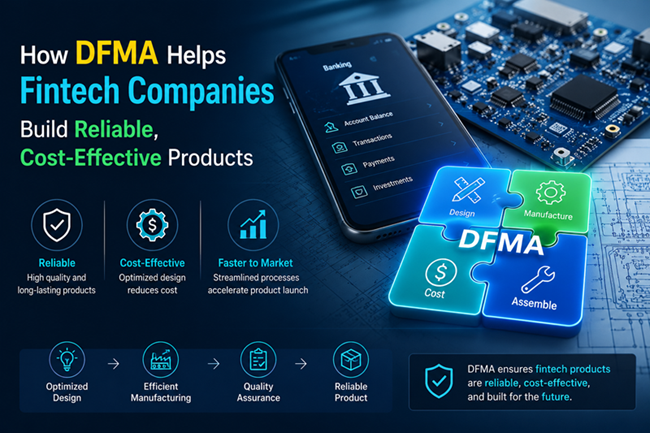
DFMA enables teams to enhance their PCB assembly process, remove redundant components, and optimize their BOMs while designing products for easy manufacturing. Rather than fixing these problems during the pilot production process, engineers can fix them while they're easy to solve and cheap to address.
Common Challenges in Fintech Device Manufacturing
Scaling the hardware process can never be easy. A hardware product that is prototyped on a smaller scale may behave differently when scaled for mass production.
The following problems often arise in hardware manufacturing processes:
- Difficulty in obtaining the required components and supplies.
- Difficult PCB designs that affect assembly and testing.
- Design changes as a result of manufacturing feedback.
- Inadequate transparency within the supply chain system.
- Unexpected rises in production costs as scaling takes place.
Many hardware developers do not realize that all of these problems are interrelated. Improved coordination between design, sourcing, and manufacturing at the early stages of the process minimizes these surprises.
Practical Ways DFMA Reduces Manufacturing Risks
In practice, successful hardware teams approach manufacturing considerations as part of product design, not a separate step.
Some practical steps are:
- Select components with stable long-term availability to simplify component sourcing.
- Design boards with automated PCB assembly in mind.
- Use rapid prototyping to validate both functionality and manufacturability.
- Optimize the BOM to reduce unnecessary part variations.
- Plan for testing and servicing before the first production run.
- Validate embedded systems under real operating conditions rather than only in laboratory environments.
While each of these advancements might appear insignificant on its own, collectively, they lead to fewer delays, increased efficiency, and easier scalability.
For businesses involved in fintech device manufacturing, adopting such an approach typically reduces production cycles and engineering changes during development.
How Better Collaboration Improves Production
The hardware development process involves many stakeholders, including product managers, electronics engineers, sourcing teams, contract manufacturers, and quality check teams.
If all these different parties are kept isolated, the assumptions made during the design process tend to conflict with reality during the manufacturing phase. For instance, the engineer could recommend a custom part that works well but has a long procurement time. Collaboration with the sourcing and manufacturing departments early on allows for alternative parts to be considered before they cause delays in the manufacturing process.
This collaboration is especially important in low-volume manufacturing processes, where design refinements can still be made without disrupting larger production schedules.
How Elecbits Helps Bring Fintech Hardware to Production Faster
Elecbits is a full-stack electronics development company that helps hardware companies bridge the gap between engineering and manufacturing by bringing design, sourcing, prototyping, and production into a single coordinated workflow. Instead of treating each stage independently, the platform enables better collaboration across PCB assembly, supplier management, BOM optimization, rapid prototyping, and manufacturing readiness.
For organizations focused on fintech device manufacturing, this integrated approach helps reduce communication gaps, improve supply chain visibility, and prepare products for smoother production scaling.
Summary
With more electronic payment solutions entering new markets, it will become increasingly difficult for engineering teams to deliver reliable designs while controlling their manufacturing costs. The companies that embrace design for assembly and design for manufacturing at an early stage have more chances to escape production pitfalls, increase the quality of products, and react to changes in demand faster. In the long term, the decisions made during the manufacturing process can give businesses the competitive edge that they never see – but always experience.