As a technique for adding surface dimension to turned pieces, this decorative process transforms smoothly finished surfaces into richly detailed works through the application of specialised cutting, carving, and abrading tools. Whether the goal is a traditional wire-brushed finish, a dramatic deep-carved geometric pattern, or a subtle surface treatment that adds tactile interest without changing the piece's overall form, woodturning texturing expands the creative vocabulary available to anyone working at the lathe in ways that conventional turning cuts cannot achieve.
Why Texture Transforms Turned Work
Plain turned forms — no matter how precisely executed — can lack the visual and tactile interest that transforms a technically accomplished piece into an emotionally engaging one. Adding surface texture through woodturning texturing creates a dialogue between the smooth, precise turned form and the organic, intentional marks that interrupt it. Light plays differently across textured surfaces, creating shadows and highlights that change with viewing angle. Touch engagement increases significantly when surfaces offer variation rather than uniform smoothness. These combined effects explain why textured turned work consistently attracts more attention than comparable untextured pieces at exhibitions and galleries.
Wire Brushing and Open Grain Techniques
Wire brushing is among the most accessible woodturning texturing techniques for turners new to surface decoration, requiring equipment found in most woodworking shops and producing results that can be dramatic or subtle depending on technique and species selection. The technique works by mechanically removing the softer earlywood from ring-porous species while leaving the harder latewood intact, creating a raised grain pattern that reflects the tree's growth ring structure. Species like oak, ash, and elm produce the most dramatic wire-brushed effects due to their pronounced difference between early and latewood density.
Rotary Carving Tool Applications
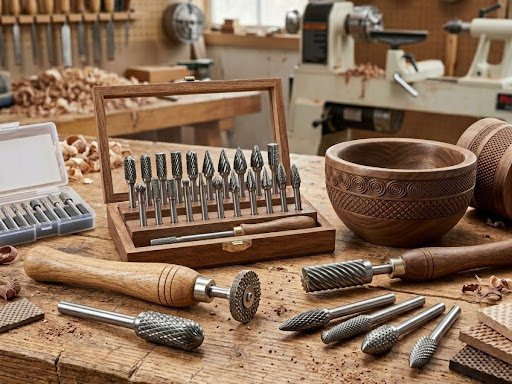
Rotary carving tools open a wide range of woodturning texturing possibilities beyond what wire brushing achieves. Mounted in a flexible shaft or rotary tool, carbide or tungsten carbide burrs and grinding points can create precise, repeatable carved patterns on the surface of turned pieces. Fluted burrs produce parallel channels that create visual movement across curved surfaces. Flame-shaped points work into concave areas that flat texturing tools cannot access. Ball-ended cutters create dimpled or pitted surfaces with a range of densities from loosely scattered to tightly packed patterns that read as solid texture at normal viewing distances.
Chatter Tool Techniques
Chatter tools produce rhythmic, repeating patterns across turned surfaces through a mechanism unlike any other surface decoration technique. These tools flex deliberately during tool contact, creating a series of repeating marks at a frequency determined by tool stiffness, lathe speed, and contact pressure. The visual effect — resembling scale patterns, basketweave textures, or concentric repeated marks depending on the parameters used — can be applied to flat surfaces, coves, beads, and gently curved areas of turned forms. Chatter tool technique is highly variable and rewards experimentation with different lathe speeds and tool geometries.
Pyrography and Burning Techniques
Heat-based surface decoration through pyrography complements woodturning texturing through its ability to darken wood selectively and permanently, creating patterns that contrast with the natural wood colour rather than creating physical surface relief. Wire burning tools dragged across spinning work create consistent, repeating bands of darkened wood. Shaped branding tools pressed against rotating surfaces produce repeating geometric burns that align naturally with the turned form. Selective burning of carved surface texture deepens the visual contrast between textured and smooth areas of complex decorated surfaces.
Texturing Tools and Brands
The market for woodturning texturing tools has expanded significantly as surface decoration has grown in prominence within contemporary turned work. Specialised texture rollers from established brands create repeating embossed patterns across cylindrical surfaces in a single tool pass. Carbide tip texturing tools designed specifically for wood lathe use provide consistent cutting performance across a wider range of hardwood species than general-purpose grinding tools. Rotary carving tools from specialist tool manufacturers like Kutzall provide the aggressive, consistent cutting action that produces the most reliable results across both soft and hardwood species.
Finishing Textured Surfaces
Finishing textured surfaces requires more careful consideration than finishing plain turned work because surface irregularity affects how finishing products penetrate, collect, and cure. Raised texture that traps excess finish creates pools that cure unevenly. Deeply carved surfaces may require thinned finish applications that flow into recesses without building up excessively on raised areas. Ebonising with dye or paint followed by selective surface removal across raised areas creates dramatic colour contrast that accentuates texture depth. Understanding how specific finish types interact with the texture profiles created by different techniques enables better finishing decisions.
For woodturners exploring woodturning texturing techniques who need access to high-quality rotary carving tools for wood that perform consistently across both soft and hardwood species, Kutzall offers a range of tungsten carbide abrasive tools engineered specifically for the controlled, consistent material removal that professional surface decoration work requires.