Cross-border trade documentation is important for businesses that import or export machinery, replacement components, and industrial supplies between the United States, Canada, and Mexico. A NAFTA Certificate was previously used to support claims for preferential tariff treatment on qualifying goods traded within North America.
Although NAFTA has been replaced by the United States-Mexico-Canada Agreement, commonly called USMCA, older records, product documentation, and historical trade references may still mention the NAFTA certificate process. Businesses working with legacy records or reviewing previous import transactions should understand what the document was used for and how current origin certification requirements differ.
Purpose of a NAFTA Certificate
The North American Free Trade Agreement created a framework for preferential tariff treatment on goods that met applicable origin requirements. A NAFTA Certificate helped an importer demonstrate that a product qualified as an originating good under the agreement.
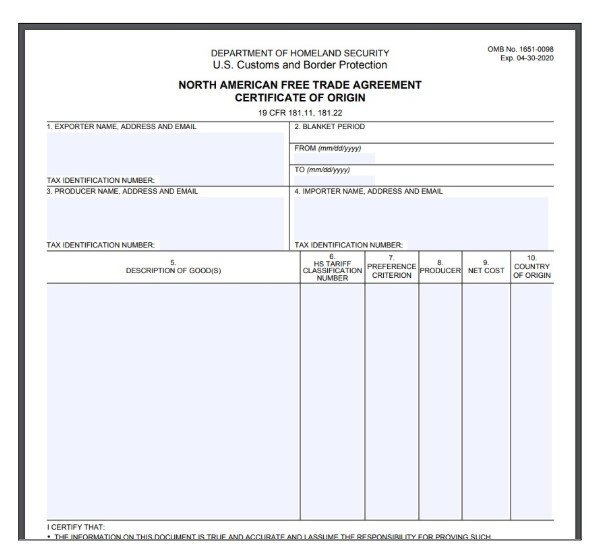
The document was used by the United States, Canada, and Mexico to determine whether an imported product could receive reduced or eliminated duty. It required accurate information about the exporter, producer, importer, product description, tariff classification, origin criterion, and certification details.
A certificate did not automatically make goods eligible for preferential treatment. The product first had to meet the applicable rules of origin. These rules considered factors such as where materials were sourced, where manufacturing took place, and whether sufficient production or transformation occurred within North America.
For machinery and industrial components, origin determination could be more complex than for goods made entirely in one country. A finished item might include materials, electronics, fasteners, belts, motors, or assemblies produced in different locations. The exporter or producer needed adequate records to support the claimed origin status.
Information Included in the Document
A properly prepared certificate required specific information that allowed customs authorities to assess eligibility. The form generally identified the businesses involved in the transaction and described the products in sufficient detail for customs review.
Important fields commonly included:
- Exporter name, address, and tax identification details
- Producer name and address
- Importer name and address
- Description of the goods
- Harmonized System tariff classification
- Preference criterion used to establish origin
- Country of origin
- Blanket period, if the certificate covered repeated shipments
- Authorized signature and date
The NAFTA Certificate could be completed by an exporter, and a producer or manufacturer could also provide origin information that an exporter could rely upon. The importer needed to possess the certificate when making a claim for NAFTA preferential treatment.
Accurate product descriptions were particularly important. Descriptions should distinguish individual items clearly and match commercial invoices, packing documentation, and internal product records. Vague wording can create uncertainty during customs review and make it harder to connect the certificate to the goods being imported.
Single-Shipment and Blanket Certificates
A certificate could apply to one specific importation or cover multiple importations of identical goods during a defined period. This latter option was commonly known as a blanket certificate.
For businesses making recurring shipments of the same qualifying product, a blanket certificate could reduce repetitive administrative work. Under NAFTA rules, the blanket period could not exceed 12 months.
However, the use of a blanket certificate required careful control. A business needed to confirm that every covered item remained identical and continued to meet the relevant origin requirements. Changes to suppliers, manufacturing processes, material sources, or product design could affect eligibility.
Companies should maintain a review process whenever a product's bill of materials changes. Even a small change in a component source may affect whether a product still qualifies under the applicable trade agreement rules.
NAFTA and Current USMCA Requirements
NAFTA ended on July 1, 2020, when USMCA entered into force. As a result, the standardized NAFTA certificate form is no longer the document used for current preferential tariff claims under North American trade rules. Canadian guidance notes that NAFTA certificates are valid only for eligible goods released before July 1, 2020, where NAFTA preferential treatment was claimed.
Under USMCA, there is no mandatory standard certificate form. Instead, an origin certification must contain specified minimum data elements. These include information about the certifier, exporter, producer, importer, product description, six-digit Harmonized System classification, origin criteria, blanket period where applicable, and authorized signature and date.
This change gives businesses more flexibility in how they prepare certification records. However, flexibility does not reduce the need for accuracy. Businesses should ensure that any statement, invoice certification, or separate origin document contains all required information and can be supported with reliable records.
Recordkeeping and Compliance
Businesses should retain documentation that supports an origin claim. Relevant records can include purchase orders, supplier declarations, bills of materials, manufacturing records, tariff classifications, commercial invoices, and shipping documents.
Under former NAFTA requirements, exporters and importers were expected to maintain certificates and related records for defined periods. U.S. guidance stated that exporters and importers generally needed to retain relevant documentation for five years.
Even when a shipment qualifies for preferential treatment, customs authorities may request additional evidence. A clear recordkeeping system helps businesses respond efficiently and reduces the risk of delayed entries, denied preference claims, or post-entry corrections.
Conclusion
The historical NAFTA Certificate was an important document for supporting preferential duty claims on eligible trade between the United States, Canada, and Mexico. While it is no longer used for current transactions, understanding its purpose remains useful when reviewing older customs records and legacy import documentation. For modern North American trade, businesses should follow USMCA origin-certification requirements and maintain accurate supporting files for each qualifying product. This is particularly important for companies handling packaging equipment and parts, where product configurations, supplier information, and country-of-origin details may change over time. Careful classification, consistent documentation, and regular origin reviews help create a more reliable trade-compliance process.